
The backing film (BOPP) gets most of the attention, but the adhesive underneath is just as important — and it's where the biggest performance differences between tapes actually come from.
Acrylic adhesive
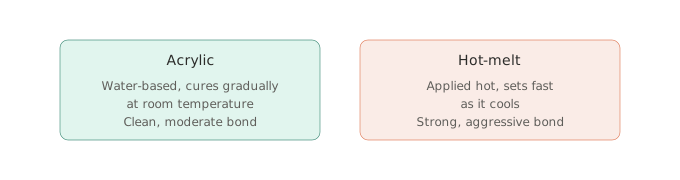
A water-based adhesive that cures to a clean, reliable bond. Key traits:
- Clean release — leaves minimal to no residue when removed, which matters for re-taping, returns, or any situation where the carton might be reopened.
- UV and temperature stable — holds up well in normal ambient conditions and doesn't degrade quickly under light exposure.
- Moderate initial tack — bonds well on clean, dry, standard corrugated board, but can under-perform on damp, dusty, or recycled board.
Acrylic is the default choice for most standard retail, ecommerce, and general B2B shipping — and it's genuinely the higher-volume choice in the Indian BOPP tape trade, not just a "cheaper fallback" option. Most day-to-day shipping needs are well served by acrylic. Note this is a water-based, pressure-sensitive adhesive (PSA) — the terms are used interchangeably in the trade.
This should be the default answer for a standard shipment — including ordinary monsoon-season and coastal shipments. Hot-melt is the exception, triggered by a specific condition (direct rain/water exposure, genuinely extended humid storage, export, poor board quality) — not a generic "stronger" option to reach for when in doubt, and not an automatic seasonal or geographic upgrade.
Hot-melt adhesive
A solvent-free adhesive applied hot and cooled to set. Key traits:
- Higher initial tack — bonds fast and strong, including on board that's slightly damp, dusty, or recycled — where acrylic can struggle.
- Stronger permanent bond — better suited to situations where the seal absolutely cannot fail, like export shipments and long-transit cartons.
- Less clean release — tends to leave more residue if the carton is reopened, and can occasionally pull at the carton surface.
- Higher cost — hot-melt tape is meaningfully more expensive than acrylic, which is part of why it's used selectively (monsoon, export, problem boards) rather than as a default.
Hot-melt is the upgrade path for direct-water-exposure shipments (e.g. open-truck transit in active rain), genuinely extended humid storage, export shipping, and recycled/lower-quality board — see the Monsoon Packaging Guide for the exposure tests; monsoon season by itself doesn't require the switch.

Side-by-side
| Factor | Acrylic | Hot-melt |
|---|---|---|
| Initial tack | Moderate | High |
| Performance on damp/recycled board | Weaker | Stronger |
| Clean release (re-taping) | Better | Weaker |
| Cost | Lower | Higher |
| Typical use case | Standard shipping, retail | Export, monsoon, heavy-duty |
| UV stability | Better | Adequate |
The simple rule
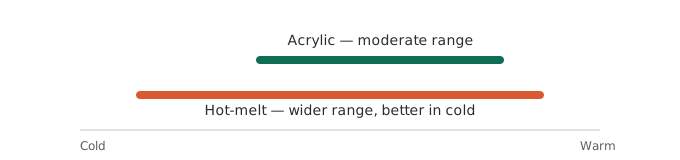
If your shipment is standard — including ordinary monsoon-season or coastal shipments with only ambient humidity — acrylic is the right default, and it's also the more cost-effective one. If your cartons face direct rain/water exposure, sit in genuinely extended humid storage, go for export, or use recycled/lower-quality board, move to hot-melt even though it costs more per roll. A seal failure costs far more than the adhesive upgrade — but that doesn't mean defaulting to hot-melt everywhere is the right call either. Since acrylic covers the majority of standard use cases well, reserving hot-melt for the situations that actually need it keeps overall packaging cost sensible.
A real-world example
A stationery wholesaler ships year-round from a single warehouse and used hot-melt tape by default, assuming "stronger is always better." After reviewing actual seal-failure data, they found almost no failures tied to adhesion — their real issue was occasional H-taping gaps on heavier cartons, unrelated to adhesive type. Switching the bulk of their volume to acrylic (with hot-melt reserved for their small monsoon-season export lane) cut their tape cost noticeably with no increase in failures — because their actual risk was a taping-pattern issue, not an adhesive-strength issue. See Common Sealing Mistakes for how to tell the two apart.
FAQ
Can I mix acrylic and hot-melt tape in the same shipment? Yes — it's common to use acrylic for most cartons and reserve hot-melt for specific ones (heavier, export-bound, or going through a particularly humid leg of transit) within the same order.
Does hot-melt tape smell or look different from acrylic? Not typically in a way that's obvious to an end customer; the practical differences (tack, release, cost) aren't usually visually apparent on the finished carton.
Is hot-melt tape worse for the environment or harder to recycle? This isn't something PackGPT should state as fact without a verified source — if a customer asks about recyclability specifically, direct them to check with PackKaro's team for accurate material/recycling information rather than guessing.
If I'm not sure which one my current supplier uses, how can I tell? The clearest sign is real-world performance: if tape peels easily and leaves little residue, it's more likely acrylic; if it has stronger initial grab and leaves more residue on removal, it's more likely hot-melt. For a firm answer, check the product documentation from your current supplier.
Unsure which fits your shipment? Talk to PackGPT with your specific conditions and get a direct recommendation.