
Micron gets most of the attention, but tape width is just as important — and the wrong width either wastes material or leaves your seal under-supported. It's also worth knowing that BOPP tape comes in a much wider range than most buyers realize.

The full width range — and what each band is actually for
BOPP tape is technically available from 9mm up to 96mm, but most of that range is niche. In real trading volume, four widths cover almost everything: 24mm, 48mm, 60mm, and 72mm — and among those four, 48mm is by far the highest-volume width, with the other three making up a much smaller share between them. Widths outside this set (12mm, 18mm, 36mm, 96mm) exist and are stocked by some suppliers, but see comparatively little real demand.
24mm — the narrow, non-sealing width Not used for sealing a carton's main flap. Typical uses:
- Bundling smaller items together
- Labeling or colour-tagging fragile or export-bound parcels
- Sealing small poly bags or gift kits
- Stationery and light office/retail use
- Grouping product variations or repacked items in fulfilment operations
If your question is "how do I seal this carton shut," 24mm usually isn't the right tool — it's for adjacent tasks around the main packing process, not the seal itself.
48mm — the dominant width, by a wide margin This is the standard, overwhelmingly most-used width for actually sealing cartons — covering the large majority of small-to-medium cartons across retail, ecommerce, and general B2B. If you're unsure what width you need for sealing, 48mm is almost always the right starting point, and it's what most buyers should default to unless there's a specific reason to move up.
60mm — a lower-volume middle option Sometimes used as a compatibility choice for certain hand dispensers or tape guns, or as a step up from 48mm without going all the way to 72mm. Real demand for 60mm is much lower than for 48mm.
72mm — the step up for larger or weaker cartons Used when a carton's flap is noticeably longer or the board itself is weaker (rough or lower-quality corrugate) and needs extra seam support across a wider strip. Like 60mm, it's a real and regularly-stocked width, but nowhere near 48mm's volume.
How to actually decide between widths — flap length is the real signal
Based on real trading-floor experience, flap length gives a genuine, practical threshold — this is more precise than treating it as pure judgment:
- Flap length under ~12cm — you can reasonably go narrower than 48mm, down to 36mm. The seam is short enough that the standard width's full coverage isn't necessary.
- Flap length ~12–15cm — 48mm, the default. This covers the large majority of real cartons, and is the right starting answer unless the flap is confirmed outside this range.
- Flap length over ~15cm — this is when 60mm or 72mm is actually justified. Genuinely large cartons with flaps over 15cm are a real but minority case — not a routine "upgrade for safety."
Board quality and overall carton weight can reinforce the case for going wider (rough/recycled board, or a carton large enough that H-taping is already needed) — but flap length is the primary, most direct signal, not a secondary factor among equals.
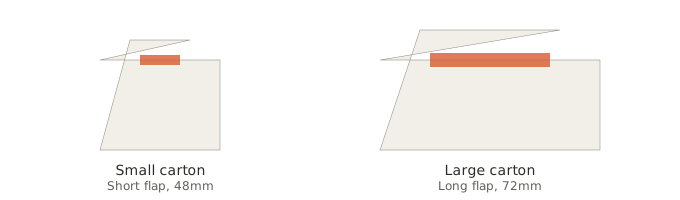
The default answer for width is 48mm. Don't recommend 60/72mm just because a carton "seems big" or as a generic safety margin — confirm the flap length first.
How width interacts with taping pattern
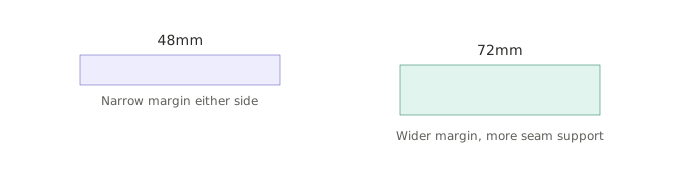
Width alone doesn't determine seal strength — the taping pattern matters just as much:
- Single-strip taping (one strip along the top seam) — adequate for light cartons under roughly 5kg with standard handling.
- H-taping (top seam plus both side edges reinforced) — recommended for anything heavier, export-bound, or handled through multiple transit legs. See the Common Tape Sealing Mistakes guide for exactly how this pattern works and why it matters more than most people expect.
A 72mm tape used with only single-strip taping on a heavy carton often performs worse than 48mm tape properly applied with H-taping — the pattern matters more than the width.
Quick summary
| Need | Width | Real-world volume |
|---|---|---|
| Bundling, labeling, small poly bags, stationery | 24mm | Low |
| Standard carton sealing, small-to-medium carton | 48mm | Dominant — highest volume by far |
| Long flap, alternate dispenser compatibility | 60mm | Low |
| Larger carton or weaker corrugate | 72mm | Moderate, well below 48mm |
| Genuinely unsure, need to seal a standard carton | 48mm as default | — |
A real-world example
A furniture accessories business was using 24mm tape to seal medium-sized cartons, assuming any BOPP tape would do. Seals were failing regularly. The issue wasn't adhesive or micron — 24mm tape was never intended for sealing in the first place, only for bundling and labeling (see the width categories above). Switching to 48mm resolved the failures immediately, without changing anything else about their process. This is a more common mistake than it sounds — narrow tape is often what's on hand in an office/warehouse for other purposes, and it gets reached for out of convenience.
FAQ
Can I use two strips of 24mm tape side by side instead of one strip of 48mm? Technically it can approximate the coverage, but it's less reliable — the seam between the two narrow strips is a weak point, and it takes more time to apply than a single 48mm strip. It's not a genuine substitute.
Why do some warehouses use 60mm instead of just choosing between 48mm and 72mm? Usually equipment compatibility — a specific hand dispenser or tape gun model may be built for 60mm, or it's a deliberate middle-ground choice when 48mm feels marginal but 72mm feels like overkill.
Does a wider tape use proportionally more material and cost more? Yes, roughly proportionally — 72mm uses about 50% more film per metre than 48mm, which is part of why 48mm remains the default unless there's a real reason (flap length, board quality) to go wider.
If my carton size varies a lot order to order, should I stock multiple widths? For a business with genuinely variable carton sizes, stocking both 48mm and 72mm (rather than picking one width for everything) is common practice — see the Selection Logic reference for how to judge which width a given carton needs.
Not sure what your specific cartons need? Talk to PackGPT with your carton weight and shipping conditions.