
Like BOPP tape, stretch film thickness is measured in microns — and picking the right gauge is about matching the film to your actual load, not defaulting to the thickest option.
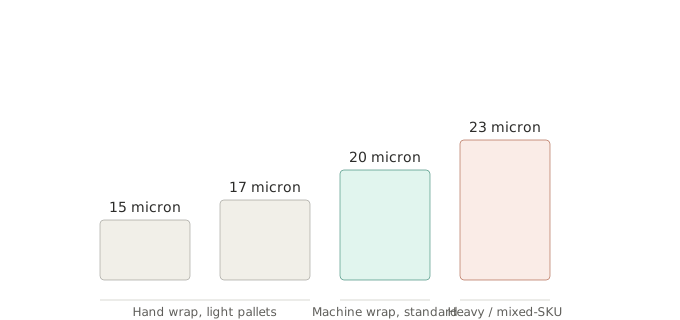
15 micron — light hand-wrap
The lightest common gauge, typically paired with pre-stretched film (see the Pre-Stretched Film guide) for light, uniform pallets under roughly 400kg. Reduces operator effort for hand-wrap applications where load containment demands are modest.
17 micron — the standard workhorse
The most common gauge for machine-wrap warehouse applications. Cast film at 17 micron (see Cast vs Blown) offers quiet unwind, good clarity, and reliable containment for standard, uniformly-loaded pallets — the safe default when you're unsure what you need.
20 micron — the upgrade for mixed loads
Recommended when pallets have mixed SKU sizes, slight overhang, or when shipping during monsoon season (see the Monsoon Packaging Guide). Often paired with blown film for the added puncture resistance mixed loads benefit from.
23 micron — heavy and irregular loads
The heavier end of the common range, suited to loads with sharp edges, irregular geometry, or higher overall weight where puncture resistance is the primary concern — see Stretch Film for Irregular Loads.

Quick decision guide

- Light, uniform pallets, hand-wrapped — 15 micron
- Standard warehouse machine-wrap — 17 micron
- Mixed SKUs, slight overhang, or monsoon season — 20 micron
- Heavy, sharp-edged, or highly irregular loads — 23 micron
A real-world example
An auto-parts distributor was using 17 micron film across all their pallets, including ones carrying mixed metal brackets with sharp edges, and experienced regular tears on those specific pallets. Rather than moving everything to a heavier gauge (which would have added cost across their entire uniform-load volume too), they identified which pallet types actually had irregular/sharp loads and moved only those to 23 micron blown film — keeping 17 micron cast film for the rest. Segmenting by load type rather than applying one gauge universally kept their overall film cost efficient.
FAQ
Is there a gauge between 20 and 23 micron, or do I have to pick one? The market range clusters around 15/17/20/23 as the common gauges; if your specific supplier offers intermediate options, those can work too, but these four cover the vast majority of real-world load types.
Does a heavier gauge always mean less stretch/cling? Not necessarily — gauge (thickness) and stretch/cling performance are somewhat independent properties, more tied to whether it's cast or blown film and the specific formulation, so a heavier gauge doesn't automatically sacrifice containment.
If my pallets are heavy but not irregular, do I need 23 micron? Not automatically — 20 micron is often sufficient for heavy-but-uniform loads; 23 micron is more specifically justified by irregular/sharp geometry, not weight alone. See the Cling Force vs Puncture Resistance guide for the distinction.
How do I explain my load type to PackGPT if I'm not sure what "irregular" means technically? Just describe it plainly — mixed box sizes, sharp corners, metal parts, uneven stacking — PackGPT can translate that into the right gauge and film-type recommendation without needing technical terminology from you.
Tell PackGPT about your typical pallet — SKU mix, weight, shape — for a direct gauge recommendation. Talk to PackGPT.