
Stretch film's core value — its ability to elongate and cling — can degrade with poor storage, even before the roll is ever used.
What affects stretch film in storage
- UV/sunlight exposure — can gradually degrade the polymer, reducing stretch capacity and cling performance over time.
- Extreme heat — can cause rolls to soften, deform, or partially fuse to their own core.
- Physical crushing — stacking heavy items on stretch film rolls, or storing them on their end rather than flat/upright as designed, can deform the roll and cause uneven unwind later.
- Extended storage of pre-stretched film — pre-stretched film (see the Pre-Stretched Film guide) can, over very long storage periods, experience some relaxation, though this is a slower effect than the factors above.
Recommended storage practice
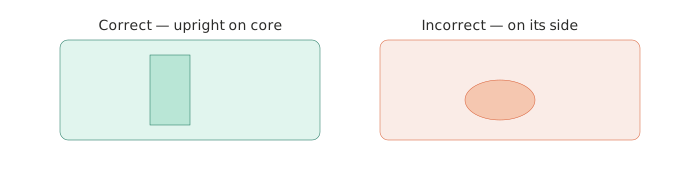
- Store rolls upright on their core, not on their side, to avoid flat-spotting the film.
- Keep away from direct sunlight and extreme heat — indoor, shaded storage is best.
- Avoid stacking other inventory directly on top of stretch film rolls.
- For bulk stock, use first-in, first-out rotation, particularly for pre-stretched film.
Handling during use

- Load rolls onto dispensers/machines carefully — dropping or dragging rolls on rough surfaces can damage the outer layers before they're even used.
- Keep partially-used rolls in a clean, dry area between shifts rather than leaving them exposed on a warehouse floor.
Typical shelf life
Under reasonable storage conditions, stretch film generally maintains good performance for 12–18 months. As with tape, this is a gradual degradation rather than a hard expiry — for older bulk stock, a quick test wrap is worth doing before committing it to a critical shipment.
A real-world example
A warehouse stored stretch film rolls on their side, stacked, to save floor space, without realizing this was flat-spotting the rolls over time. Operators noticed increasingly uneven unwind and occasional film snapping mid-wrap, and initially assumed it was a bad batch from their supplier. Switching to upright storage on proper shelving eliminated the issue on the next batch of rolls — the storage method, not the film itself, was the cause.
FAQ
Can flat-spotted film still be used, or should it be discarded? Lightly flat-spotted rolls can often still be used with some care during application, but if unwind is visibly uneven or the film shows creasing, it's safer to set that roll aside for a lower-priority use rather than a critical shipment.
Does pre-stretched film have different storage requirements than standard film? The core storage principles (upright, shaded, moderate temperature) are the same, though very long storage of pre-stretched film can allow some relaxation of the pre-applied stretch over time — see the Pre-Stretched Film guide.
Is outdoor covered storage acceptable, or does film need to be fully indoors? Covered outdoor storage (shaded from direct sun and rain) can be acceptable for shorter-term storage, but temperature swings and humidity exposure are harder to control outdoors — fully indoor storage remains the safer choice for longer holding periods.
How can I tell if a roll has degraded without unwrapping and testing the whole thing? A quick partial unwind and stretch test on a small section is usually enough to judge tack and stretch behaviour without committing the full roll — this is a reasonable spot-check before using older stock on an important shipment.
Setting up bulk storage for a new warehouse? Talk to PackGPT for practical guidance.