
Stretch film selection often gets reduced to "which micron" — but underneath that is a real trade-off between two distinct properties that don't always move together.
Cling force
How tightly and consistently the film grips itself and the load as it's wrapped. High cling force matters for:

- Load stability during transit — preventing shifting or loosening
- Clean, tight-looking pallets (relevant for customer-facing or export shipments)
- Uniform, regularly-shaped loads where consistent tension is achievable
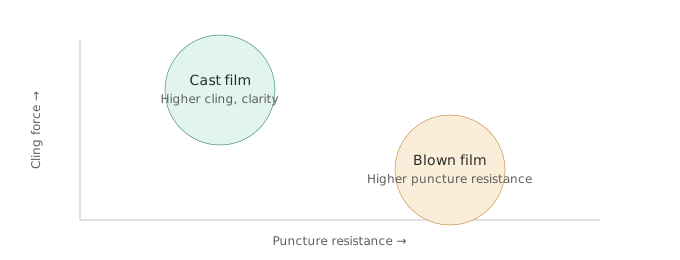
Cast film (see Cast vs Blown) generally offers stronger, more consistent cling.
Puncture resistance
How well the film resists tearing when it meets a sharp edge, corner, or irregular protrusion on the load. High puncture resistance matters for:

- Mixed-SKU pallets with inconsistent shapes
- Loads with sharp corners, metal edges, or protruding parts
- Any situation where a single tear could compromise the whole wrap
Blown film generally offers meaningfully better puncture resistance than cast film at the same gauge.
Why this is a genuine trade-off
These two properties don't scale together — a film optimized purely for cling tends to be more vulnerable to punctures, and a film optimized for puncture resistance tends to have a slightly different (sometimes hazier) surface that clings less aggressively. There's no single "best" film — the right choice depends on which failure mode your actual loads are more prone to.
Practical guidance
- Uniform, boxed pallets, no sharp edges — prioritize cling force, cast film
- Mixed SKUs, irregular shapes, sharp corners — prioritize puncture resistance, blown film
- Genuinely unsure — 20 micron cast film is a reasonable middle-ground default; see the Micron Guide
A real-world example
A packaging buyer assumed "stronger film" meant one property — pick the toughest option available — and was confused why their supplier offered both cast and blown at similar gauges with different prices. Once the cling-vs-puncture distinction was explained against their actual pallets (uniform boxed inventory, no sharp edges), it became clear cast film's stronger cling was the more relevant property for them, not blown film's puncture resistance, even though blown is sometimes assumed to be the "premium" option.
FAQ
Is blown film always more expensive than cast film? Generally somewhat more, reflecting production complexity, but the gap isn't dramatic — the bigger cost driver is usually gauge, not cast-vs-blown, so the film-type choice shouldn't be avoided purely on cost grounds if your loads genuinely need puncture resistance.
Can I combine both properties by using a thicker cast film instead of switching to blown? Increasing cast film's gauge does improve its puncture resistance somewhat, but it doesn't close the gap with blown film's puncture performance at a comparable gauge — for genuinely sharp/irregular loads, film type matters more than just adding thickness to cast film.
Does temperature affect cling force? Cling performance can be somewhat temperature-sensitive, similar in principle to how BOPP tape adhesive is affected by extreme cold — see the North India Winter Guide for the general mechanism, which applies conceptually to film as well.
How do I know which property my specific pallets need without technical testing? Look at your actual failure pattern: if pallets shift/loosen, that points to cling; if the film tears at specific points, that points to puncture resistance. The failure mode itself is usually a reliable enough signal without formal testing.
Describe your typical pallet to PackGPT and get a direct film-type recommendation. Talk to PackGPT.