
Stretch film splits into two broad categories based on how it's applied — and using the wrong one for your operation either wastes film or wastes labour.
Hand wrap
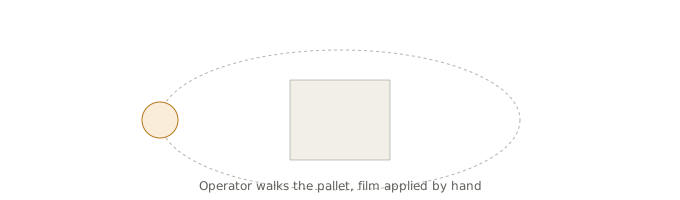
Designed to be applied manually, wound around a pallet by a person walking around it with the roll (often mounted on a handle/dispenser). Key traits:
- Narrower width (commonly 250mm) for manageable handling
- Often pre-stretched — see the Pre-Stretched Film guide — to reduce operator physical effort
- Best suited to low-volume, irregular, or occasional pallet wrapping where a dedicated wrapping machine isn't justified
Machine wrap
Designed for pallet-wrapping machines — either turntable or rotary-arm style — that mechanically rotate the pallet or the film dispenser. Key traits:

- Wider (commonly 500mm) since the machine handles the physical stretching and application consistently
- More consistent tension and coverage than hand application, run after run
- The standard choice for any warehouse doing regular, higher-volume palletized shipping
How to decide
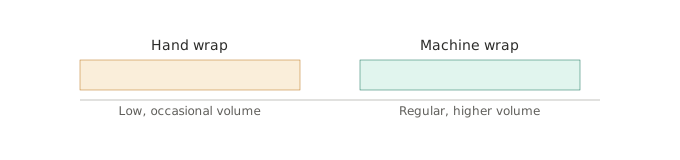
| Factor | Hand wrap | Machine wrap |
|---|---|---|
| Volume | Low, occasional | Regular, high |
| Consistency | Depends on operator | Consistent |
| Labour effort | Higher per pallet | Lower per pallet (machine does the work) |
| Upfront equipment cost | None | Wrapping machine required |
| Typical width | 250mm | 500mm |
If your operation wraps more than a handful of pallets a day, the labour savings from machine wrap typically justify the equipment cost fairly quickly. For occasional or one-off wrapping, hand wrap remains the more practical choice.
A real-world example
A growing distributor started with hand-wrapping 15–20 pallets a day and assumed a wrapping machine wasn't worth it yet. After tracking actual labour hours spent wrapping over a month, they found it consumed nearly a full staff-day per week — enough to justify a basic turntable machine, which paid for itself in reduced labour within a few months. The lesson wasn't "machine wrap is always better," it was that the volume threshold for justifying machine wrap is often lower than businesses initially assume, because the ongoing labour cost compounds.
FAQ
Is there a rotary-arm option instead of a turntable, and does it matter which I choose? Yes — rotary-arm machines rotate the film dispenser around a stationary pallet instead of rotating the pallet itself, which is useful for very heavy or unstable loads that shouldn't be spun. The choice depends more on load type than a general preference.
Can I use pre-stretched film with a machine, or is that only for hand wrap? Machine wrap typically applies its own controlled stretch during the wrap cycle, so pre-stretched film's main labour-saving benefit is less relevant there — see the Pre-Stretched Film guide for where it matters most.
How much does a basic wrapping machine typically cost to get started? This varies widely by machine type, capacity, and supplier, and isn't something PackGPT should state as a fixed figure — this is a question for equipment suppliers directly, separate from PackKaro's film/tape product line.
Does switching to machine wrap change what gauge of film I need? Not directly — gauge is still driven by load type (see the Micron Guide), though machine wrap's more consistent tension can sometimes allow a slightly lighter gauge to achieve the same containment that inconsistent hand-wrapping would need a heavier gauge to match.
Scaling up your warehouse operations? Talk to PackGPT for a recommendation based on your actual pallet volume.