
If you're buying stretch film for the first time, or reassessing your current spec, this guide pulls together the key decisions in order.
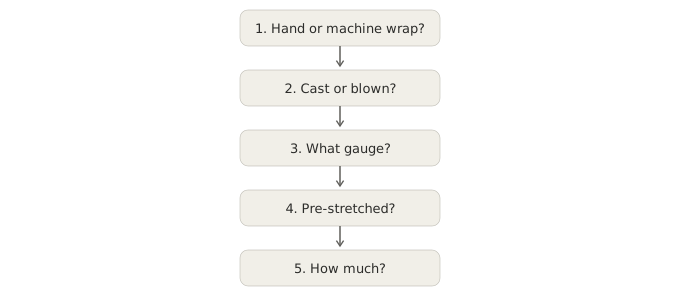
Step 1: Hand wrap or machine wrap?
This is the first fork in the decision tree and affects everything downstream. See Hand Wrap vs Machine Wrap for the full comparison — in short, machine wrap suits regular, higher-volume operations, while hand wrap suits occasional or lower-volume wrapping.
Step 2: Cast or blown film?
Cast film (clearer, quieter, better cling) is the standard default for uniform pallets. Blown film (better puncture resistance) is the upgrade for irregular or mixed-SKU loads. See Cast vs Blown and Cling Force vs Puncture Resistance for the detailed trade-off.
Step 3: What gauge (micron)?
Match thickness to your load — see the Micron Guide for the full 15/17/20/23 micron breakdown by use case.
Step 4: Pre-stretched or standard?
If you're hand-wrapping regularly, pre-stretched film is worth evaluating for both labour savings and material yield — see Pre-Stretched Film Explained.
Step 5: How much do you need?
Estimate consumption using the practical method in How Much Stretch Film Do You Need before placing a bulk order.
A note on pricing structure

Stretch film, like most bulk packaging materials, is typically priced with quantity-break tiers — a base price per roll, dropping at defined bulk thresholds. If you're ordering regularly, it's worth checking where your typical order volume sits relative to the next pricing tier; a small increase in order size sometimes crosses a threshold that meaningfully reduces per-roll cost.
Putting it together — a worked example

A warehouse shipping mixed-SKU pallets (some irregular shapes, moderate weight) via machine wrap, moderate volume:
- Wrap method: Machine wrap (regular volume justifies the equipment)
- Film type: Blown (irregular shapes need puncture resistance)
- Gauge: 20 micron (mixed loads, per the Micron Guide)
- Pre-stretched: Not applicable (machine wrap already applies controlled stretch)
FAQ
I'm just starting out and don't know my pallet volume yet — where should I begin? Start with hand wrap and standard cast film at 17 micron as a safe, low-commitment default, then reassess once you have a few weeks of real volume and load-type data — see How Much Stretch Film Do You Need for tracking your actual usage.
Can I switch specs later without wasting my current stock? Yes — most businesses evolve their spec over time as volume and load types change; existing stock can usually be used for whichever pallet types it still suits (e.g. keep using cast film for uniform loads even after adding blown film for irregular ones) rather than needing to be replaced all at once.
Does PackKaro sell both cast and blown film, and can I order both in one bulk purchase? Check the current catalog or generate a quote specifying both film types and your required gauges — PackGPT can help structure a combined order if you have multiple pallet profiles.
What's the single biggest mistake first-time bulk buyers make? Buying one film type/gauge for their entire operation without accounting for load variability — see the worked example above. Segmenting by actual load type, even into just two categories (uniform vs irregular), usually gives better results than a one-size-fits-all purchase.
Ready to get a specific recommendation for your operation? Talk to PackGPT or generate a quote once you know your spec.